There is something special about travelling overland, through tree lined avenues, combining land based excusions exploring local cultural landmarks and attractions. Countries which involved France Belgium, Germany and the Netherlands.
Holidaying in the Germany's Mosel Valley was one of the most idyllic settings i have ever experienced. The beautiful Mosel Valley, home of renowned winelands, was where I spent a lovely four days. The rustic wine bars and wine tasting cellars nestled in enchanting medieval towns alongside craggy castles. We visited three towns including Brodenbach, Cologne and Rudesheim traveling between two rivers the Mosel and the Rhine!
Brodenbach has some of the most beautiful landscape views, from valley to mountain side and the roads offer a challenge to road users. The village is set on the right of the Mosel it hosts churches and a ruined castle.
If you’re a fan of negotiating challenging bends, with great views, long fast straights and with little to no traffic, then these road networks may excite you.
The 125 mile long 'Mosel Wine Road' stretches from Koblenz to the ancient city of Trier. The area's almost complete lack of industrialization and development means that the scenery remains magnificent and the villages are peaceful and charming. The great Mosel River snakes in huge curves through the valley. It is an important trade route and heavily laden barges continue to ply up and down as they have done for centuries. But it is the Mosel's wines, excellent dry white Rieslings, which attract most of the visitors.
Vineyards cover nearly every sunny slope of the steep-sided valley. Rough stone terraces, some large enough only to support a few dozen vines, rise precipitously above the river and vineyards cling to the hillsides at crazy angles. The trip meandered through the lower reaches of the vineyards and the thousands upon thousands of identical rows of low green leafy vines can become quite mesmerizing. Our Hotel The Arken Hotel nestled in a nook of the meandering Mosel. And a glass of wine over a relaxing meal was most welcome after our fun filled excursions..
Staying in these private rooms is a great way to meet the local people.
As with the nearby Rhine Valley, (the mosel is a tributary of the Rhine), grapes have been grown for wine along the Mosel since Roman times. The mechanization that has made the lives of vintners in other areas so much easier has proved difficult or impossible to apply to many of the Mosel's steeply-angled vineyards. Thus wine production here is still a tough, back breaking job and in that way little has changed over the last 2000 years. From pruning and weeding to the harvest itself, much of the work is still done by hand. Despite free accommodation, hearty meals and decent wages there is often a shortage of reliable workers at harvest time.
All the hard work, however, is well rewarded in that it produces wines of exceptional quality. In fact, the very things that make cultivation so strenuous are important factors in the wines' quality—the steep slopes maximize the sunshine that reaches the vines and the stony ground absorbs heat during the day and slowly releases it during the night. This results in fantastic wines famous worldwide.
Small wine-producing villages are strung along both sides of the river, often only a few miles apart. Each has an assortment of caf�s and 'Wein Stube' (cozy bars selling locally produced wines) and many retain a wonderfully medieval atmosphere with gabled half-timbered houses lining quaintly crooked cobbled lanes.
From the small settlement of Brodenbach, we travelled, to the city centre of Cologne it was touched by the magic of the festivities of christmas. I visited the magic of Cologne the seven Christmas markets was just one fun filled day during Advent, alongside many other visitors from around the world delight at the goods on sale at the "Buden".
Christmas music filled the city centre, with local artefacts and crafts, toys, Christmas decorations and the scent of the freshly made coffee creating a wonderful atmosphere. It is not just children's eyes that light up when pewter pourers, wreath binders and glassblowers demonstrate their art, and the aroma of mulled wine, hot chestnuts and gingerbread fills the air.
The variety of entertainment included a visit to a Picasso exhibition, the young Doctor Ludwig did a thesis on Picasso and had since gathered the third largest collection of the artist. In this exhibition presented at the Ludwig Museum until January 15th 2012 Doctor Kerstin Stremmel wants to show that the face of Picasso is as well known as his oeuvre . He was portrayed by the most famous photographers and some of these pictures have become iconic. MeMyselfand photo portraits of Picasso brings together prints from 250 photographers such as Richard Avedon, Cecil Beaton,Henri Cartier Bresson, Lee Miller and Man Rayand a visit to Cologne Cathedral.
The Cologne Cathedral another attraction, majestic structure is one of the finest I have visited - known as one of the world's great cathedrals: it is the spiritual and geographical heart of the city. The largest Gothic cathedral in Germany. From the top of the south tower, overlooks the panoramic views of the city and surrounding area.
Its construction began in 1248, housing the relics of the three Magi brought to Cologne in 1164 by the Archbishop Reinald von Dassel, chancellor to Frederick Barbarossa. After the completion of the chancel, south tower, and north-side aisles (around 1500), work was halted and not resumed until 1823. In 1880, the great enterprise was completed, and unlike many time-consuming constructions that change styles in midstream, the final result was in the Gothic style, true to the original plans.
The overall view of the cathedral, from the south transept, you actually can get an idea of its actual size and splendor. The west side (front) is dominated by two towering spires, perfectly proportioned and joined by the narrow facade of the nave. The first two stories of the towers are square, gradually merging into the octagonal form of the top three stories and tapering off at the top with huge finials. There is no great rose window, so characteristic of Gothic architecture, between these spires.
The west doors (main entrance), you are immediately caught up in the cathedral's grandeur. Although this portion of the church is somewhat bare, the clerestory and vaulting give a feeling of the size of the edifice. The towering windows on the south aisles include the Bavarian windows, donated by King Ludwig I of Bavaria in 1848. Like most windows in the nave, they are colored with pigments that have been burned on rather than stained. In the north aisles are the stained-glass Renaissance windows.
The Rhine is one of the longest and most important rivers in Europe. Until 1932 the generally accepted length of the Rhine was 1,230 kilometres (764 miles). It meanders through several countries, I viewed it from several points the most impressive was behind Cologne Cathedralby the banks of the Rhine.
Rudesheim, hosts a beautiful christmas market. This towns history has left a rich heritage here in the wine-growing Rheingau region whose origins date back to pre-Roman times. The inescapable romanticism of the Rhine, the historic palaces and ancient castles, excellent riesling and pinot noir wines, together with Rüdesheim's famous hospitality and conviviality give the town a very distinctive atmosphere.
Tuesday, 27 December 2011

Monday, 19 September 2011
York Lincoln and Hull

I travelled to York not only physically but also through the timeline of its history from 71AD named by the Romans as EBORACUM to the 700s when it was known as EOFORWIC named by the Saxons and in 866 the Vikings captured the city and renamed it JORVICK.
Infamous character Dick Turpin was hanged here in 1739.
Most importantly for me:
York:
Home of the Quaker villages built by Joseph Rowntree of which there are four.
In 1901, Joseph's son Seebohm Rowntree published a study of the living conditions of the working classes in York. This report entitled Poverty: was a study of town life. It revealed appalling statistics of dark, overcrowded and insanitary housing.
Joseph Rowntree's conviction that it must be possible to provide better housing for people on low incomes led him to acquire 150 acres of land near the village of Earswick, two and a half miles to the north of the centre of York. The planner Raymond Unwin and the architect Barry Parker were commissioned to produce an overall plan for a new 'garden' village and the detailed designs for its first houses. They were to go on to design the garden cities of Letchworth and Welwyn. New Earswick was one of their first opportunities to put their ideas into practice.
The building of New Earswick was an attempt to create a balanced village community where, although rents were to be kept low, they should still represent a modest commercial return on the capital invested. Houses there were to be open to any working people, not just Rowntree employees. The village was to be a demonstration of good practice: if New Earswick was successful, Joseph hoped that similar communities would be built elsewhere in the country.
At Joseph Rowntree's insistence, houses had gardens with fruit trees and enough ground to grow vegetables. The Trust Deed of the Joseph Rowntree Village Trust (which was set up in 1904 to build and manage New Earswick) safeguarded generous open green space. All the grass verges were planted with trees and almost all the roads are named after trees. The village was built from the very ground it stands on: the bricks were made in the brickworks on the outskirts of New Earswick. From 1950 the brickyard, which closed down in the 1930s, was developed into a nature reserve.
New Earswick continues to be a thriving community with a range of facilities, projects and programmes for involving residents of all ages. Accommodation in New Earswick includes housing for families and single people sheltered, housing and care for older people, bungalows and studio flats.
York Minster in comparison to the poverty shown in the above text.
As a visitor to York Minster, a vision of the long history of northern Europe's greatest Gothic cathedral. Every age from the Roman occupation of York onwards to the future of this working and worshipping church. The experience of the Minster shows the wealth of beauty through outstanding architecture, the Quire, Chapter House, Undercroft, treasury and Crypt.
The Minster has outstanding collections of artefact's, records and books, dating from Roman times to the present day. The collections are maintained and developed as a witness to the Christian faith, these are used by the Minster to support its education programme and in other important aspects of its work.
The Usher Gallery York:
I viewed a piece of work of Laurence Stephen Lowry who was born in 1887, in Manchester. An only child he began to draw at the age of eight and began private painting classes at the age of fifteen, the year before he left school. In 1904, he joined a firm of chartered accountants as a rent-collector and clerk and he remained in full-time employment throughout his life until he retired at the age of 65. So concerned was he to be seen as a serious artist that it was not until after his death that it was revealed that he had actually made his living away from the easel.
By the early 1930s he was exhibiting at the Royal Academy in London. He was awarded an honorary MA at Manchester University in 1945, and Doctor of Letters in 1961, elected to the Royal Academy in 1962, and given freedom of the City of Salford in 1965.
He lived in Mottram until he died in 1976 - a death marked by unprecedented homage by the 'ordinary people' of Manchester.
L.S. Lowry is unquestionably one of the most celebrated British artists and his unique contribution to recording the period, culture and landscape of industrial Salford and Manchester is without parallel. His work is a most distinctive and comprehensive record of the pre and post World War Two northern industrial town.
Many people associate Lowry with “matchstick men”, but he is known to have produced over 10,000 works, ranging from finished oil paintings to hastily drawn sketches. The local industrial scene was his most frequent subject but he also painted seascapes and portraits. He was a great humorist and had intense insight into human nature, characterising it without sentiment.
At the gallery I saw a 1952 commission part of a topographical collection- The Clifford Tower which was unusual as the Tower was being viewed by only a few of his "matchstick men". He was one of twelve artists to paint Clifford Tower.
The stunning panoramic views from the top of Clifford’s Tower, out over the historic city of York, makes it one of the most popular attractions in Yorkshire.
Set on a tall mound in the heart of Old York, this imposing tower is almost all that remains of York Castle, which was originally built by William the Conqueror.
The tower has served as a prison and a royal mint, as well as the place where Henry VIII had the bodies of his enemies put on public display.
Lincoln
A beautiful city which is steeped in history, and brimming with life. The city looks back over 2,000 years of history and discover the city's Roman, Norman, Medieval, Tudor and Georgian heritage.
In the first century the city was called Lindum Colonna and inhabited by demobbed Roman legionnaires and their families. One of the most visible remains of this period is Newport Arch built by the Romans over Ermine Street and still in use by traffic today.
I climbed The Steep Hill to the awe inspiring as Lincoln Cathedral - started in 1072; the original building was damaged by fire and earthquake. Apart from the Norman West Front, the existing Cathedral is largely 12Th and 13Th century. William the Conqueror's castle dates from 1068, the medieval ramparts give magnificent views over Lincoln. Unique Victorian Prison Chapel and King John's 1215 Magna Carta (one of only four in existence).
The Guildhall an ancient Council Chamber contains Lincoln's civic Insignia, considered the finest collection of civic regalia outside
The Collection Art and Archaeology:
These collections contain both artefact's and objects from archaeological and art collections.
The art collection is the finest in the county. It includes superb contemporary art and craft, paintings, sculpture, porcelain, clocks and watches. Treasures include paintings by Turner, Stubbs and Lowry, major porcelain collections and clocks with wooden movements by Robert Sutton.
The archaeological collection covers 300,000 years of history from the earliest inhabitants of Lincolnshire to the Eighteenth Century. Some highlights of the collections are prehistoric finds from the River Witham, treasures from Anglo-Saxon burials and finds from Lincoln’s rich Roman, Viking and Medieval heritage.
For me the trail through the archaeological remains revealed the dawn of the humanities through evidence of humankind alongside the cutting edge of contemporary art.
If I had a favourite the dug out boats from the river bed and the bronze age masks took me back to my school days where we completed pencil drawings of such artefact's.
Hull
Known as Kingston upon Hull. History travels through the majestic mammoths to Saxon invaders, as a visitor to the Hull I lived through the experience of a unique, educational experience, involving fun. The Iron Age village and Iron Age weaponry, Roman bath house with stunning mosaics. And a horde of Viking treasure!
Hull’s unique Museums Quarter - consists of Wilberforce House, the Hull and East Riding Museum, Streetlife and the Arctic Corsair trawler - fun exploring and discovering historic Hull. The Ferens Art Gallery and the Maritime Museum in the city centre, and Hands On History in Trinity Square right in the heart of the City Centre.
Ferens Museum:
I viewed Bigger Tree Near Warter.

David Hockney: Bigger Trees Near Warter
David Hockney's painting Bigger Trees Near Warter, on loan from Tate, is the largest painting the artist has ever produced and measures 40 x 15 feet (12 x 4 metres).
It features two copses, a huge sycamore tree, buildings and early flowering daffodils, the painting comprises of 50 individual canvas panels and takes inspiration from a site at Warter in the Yorkshire Wolds. A beautiful experience.
Watching a video of Hockney, painting en plein air (outside) in six weeks. It explained how the artist used digital technology to help him complete the painting, creating a computer mosaic of the picture which enabled him to 'step back' and see it as a whole.
The painting depicts a landscape prior to the arrival of Spring and before the trees have come into leaf
Thursday, 18 August 2011
Peppa Pig visits Drusillas

As we all know childrens education is based on interactive play Drusillas offer activities…and we had fun finding out!
The Drusillas experience offer oodles of hands-on kids educational activities and interactive displays that aim to bring learning to life. At Drusillas, we learnt as having fun with our hands-on activities, which we followed around the Zoo Route we asked qusetions of HOW, WHY and WHAT as we were able to gain a sensory experience in close and personal contact with farm animals and saw recently hatched birds.

We travelled on Thomas the Tank Engine with Friends, Thomas, Annie and Clarabel provide a train service throughout the day, a fatastic attraction! We alighted the train at Tidmouth Halt. 'Thomas the Tank Engine' took us through the paddocks. seeing the Fat Controller at Dryaw Halt, James in the engine shed, we saw Diesel around the track, and spotted Cranky in the Sodor Dock yard. Alongside this we viewed the beautiful gardens in Alfriston.
A special event led to the introduction of Peppa Pig, George Pig and dino the dinosaur.

A song we like to sing is based on dinosaurs.
The song is ‘I’m a mean old Dinosaur’
I’m a mean old Dinosaur (make a mean face)
Big and tall (hand movements indicate size)
Here is my tail and here is my claw (hand behind their back and a claw shaped hand)
When i get hungry (rub your tummy)
I just growl
RAAAAAAAAAAAAAHH!!
Look out kids I’m on the prowl.
This song is sang to the tune of ‘I’m a little teapot ‘
We saw another interactive session hosted in Churchill Square The dinosaur exhibition. Huge animals, including the terrifying T-Rex, the ‘tyrant lizard’ and king of the dinosaurs!
Alongside the giant T-Rex is fellow Cretaceous-dweller and carnivore, the Baryonyx, a 28ft-long dinosaur with huge claws and finely serrated teeth!
Slightly more mild-mannered in comparison, what the Oviraptor lacked in ferocity it certainly made up for in speed! Just six foot long, the bird-like dinosaur from the Cretaceous period falls into the theropod category alongside the lithe-limbed Ornithomimus.
Dinosaur creative play is fun...planning sessions for the indoor and outdoor environments including scaly dinosaurs and finger painting.
Other creative sessions involving children in action movement and rhyme, this sesssion allows the children to show how to express mathematical skills through hand movement..
Dinosaurs lived when the earth began
Some were tall
Some were small
Some liked water
Some like land
Pteranadons had leathery wings
Brontosauras long necks
But the meanest of all was Tyrannosaurus Rex
Raahhh.....
Sunday, 6 March 2011
The Isle of Wight 2011
Taking a short break.
I visited this wonderful island visiting, Godshill, Shanklin, Sandown, The Needles.
The Isle of Wight is a pituresque lowland. The impact of the sea, the quality of the light, the temperate climate and the variety of cultural influences give its own strong 'sense of place'.
We stayed at the town of Sandown, an area which is treasured for its special qualites. The complex and diverse character of the island offers the opportunities it provides for quiet enjoyment, peace and relaxation are equally valued today I reflected on other poets that had visited this island, near to Sandown the town of Shanklin which heralds memories of Keats and Longfellow, Tennyson and Freshwater Bay.
As soon as Keats reached the Isle of Wight, on April 16, 1817, he went to see Shanklin and Carisbrooke, and after some hesitation between the two, decided on a lodging at the latter place.
ON THE SEA
It keeps eternal whisperings around
Desolate shores, and with its mighty swell
Gluts twice ten thousand Caverns, till the spell
Of Hecate leaves them their old shadowy sound.
Often 'tis in such gentle temper found,
That scarcely will the very smallest shell
Be mov'd for days from where it sometime fell,
When last the winds of Heaven were unbound.
Oh ye! who have your eye-balls vex'd and tir'd,
Feast them upon the wideness of the Sea;
Oh ye! who have your eye-balls vex'd and tir'd,
Feast them upon the wideness of the Sea;
Oh ye! whose ears are dinn'd with uproar rude,
Or fed too much with cloying melody -
Sit ye near some old Cavern's Mouth, and brood
Until ye start, as if the sea-nymphs quir'd!
At the Crab Inn in the old village part of Shanklin during July 1868. Longfellow wrote to a friend that he was staying in a lovely little thatched-roof inn, all covered with ivy. Whilst staying here he was asked to write an inscription which now embelishes the fountain outside. It is displayed on a shield with the Union Jack and the Stars & Stripes on either side and reads:
O traveller, stay they weary feet;
Drink of this fountain pure and sweet;
It flows for rich and for poor the same.
Then go thy way remembering still
The wayside well beneath the hill,
The cup of water in His name.
Whereas Poet laureate Tennyson who lived at Farringford from 1853 until the end of his life in 1892. Tennyson wrote of Farringford:
“Where, far from noise and smoke of town
I watch the twilight falling brown,
All round a careless-ordered garden,
Close to the ridge of a noble down.”

Godshill and its magnificent warmth, it reflected the old island which was the last part of the British Isles to accept christianity.


Sandown is the best place to have fun sandy beaches access the sea safely. Lifeguards on patrol to watch over the shore and to help make your visit as relaxing and enjoyable as possible.
Sandown seafront is just yards from the town's shops, cafes, pubs and restaurants, with easy level walking along the broad promenades and sea wall. You will find deckchairs, beach huts, water sports and the pier, which dates from 1879 and now provides all-weather amusements.


This diamond-shaped island has a magic all of its own and is one of the UK's sunniest and warmest places. Measuring 23 miles by 13 miles, the Isle of Wight lies just off England's South Coast. No passport is needed for the short sea crossing - and once you've landed on the Island everything is within easy reach.
I visited this wonderful island visiting, Godshill, Shanklin, Sandown, The Needles.
The Isle of Wight is a pituresque lowland. The impact of the sea, the quality of the light, the temperate climate and the variety of cultural influences give its own strong 'sense of place'.
We stayed at the town of Sandown, an area which is treasured for its special qualites. The complex and diverse character of the island offers the opportunities it provides for quiet enjoyment, peace and relaxation are equally valued today I reflected on other poets that had visited this island, near to Sandown the town of Shanklin which heralds memories of Keats and Longfellow, Tennyson and Freshwater Bay.
As soon as Keats reached the Isle of Wight, on April 16, 1817, he went to see Shanklin and Carisbrooke, and after some hesitation between the two, decided on a lodging at the latter place.
ON THE SEA
It keeps eternal whisperings around
Desolate shores, and with its mighty swell
Gluts twice ten thousand Caverns, till the spell
Of Hecate leaves them their old shadowy sound.
Often 'tis in such gentle temper found,
That scarcely will the very smallest shell
Be mov'd for days from where it sometime fell,
When last the winds of Heaven were unbound.
Oh ye! who have your eye-balls vex'd and tir'd,
Feast them upon the wideness of the Sea;
Oh ye! who have your eye-balls vex'd and tir'd,
Feast them upon the wideness of the Sea;
Oh ye! whose ears are dinn'd with uproar rude,
Or fed too much with cloying melody -
Sit ye near some old Cavern's Mouth, and brood
Until ye start, as if the sea-nymphs quir'd!
At the Crab Inn in the old village part of Shanklin during July 1868. Longfellow wrote to a friend that he was staying in a lovely little thatched-roof inn, all covered with ivy. Whilst staying here he was asked to write an inscription which now embelishes the fountain outside. It is displayed on a shield with the Union Jack and the Stars & Stripes on either side and reads:
O traveller, stay they weary feet;
Drink of this fountain pure and sweet;
It flows for rich and for poor the same.
Then go thy way remembering still
The wayside well beneath the hill,
The cup of water in His name.
Whereas Poet laureate Tennyson who lived at Farringford from 1853 until the end of his life in 1892. Tennyson wrote of Farringford:
“Where, far from noise and smoke of town
I watch the twilight falling brown,
All round a careless-ordered garden,
Close to the ridge of a noble down.”

Godshill and its magnificent warmth, it reflected the old island which was the last part of the British Isles to accept christianity.


Sandown is the best place to have fun sandy beaches access the sea safely. Lifeguards on patrol to watch over the shore and to help make your visit as relaxing and enjoyable as possible.
Sandown seafront is just yards from the town's shops, cafes, pubs and restaurants, with easy level walking along the broad promenades and sea wall. You will find deckchairs, beach huts, water sports and the pier, which dates from 1879 and now provides all-weather amusements.


This diamond-shaped island has a magic all of its own and is one of the UK's sunniest and warmest places. Measuring 23 miles by 13 miles, the Isle of Wight lies just off England's South Coast. No passport is needed for the short sea crossing - and once you've landed on the Island everything is within easy reach.
Sunday, 14 November 2010
75 years celebration at Bexhill DeLa Warr

The De La Warr Pavilion is a local Grade One Listed Modernist icon which houses contemporary arts on the sea-front in Bexhill on sea.
On August Bank Holiday Monday I visited this celebration it was one of the most moving events that I have visited. The mass collected within the grounds re-creating one of the most famous images of the De La Warr Pavilion. A reflection of images in 1936.
The De La Warr Pavilion was designed by Erich Mendelsohn and Serge Chermayeff and opened in 1935 as the first public building built in the Modernist style in the UK. Constructed with steel and concrete, it posed a new and exciting challenge for its structural engineers F J Samuely and Partners who built their reputation on their association with the Pavilion. Samuely's have advised the Pavilion on the positioning of Critical Mass to ensure that the weight of the sculptures do not compromise the structure or materials of the roof space.
We arrived at the Pavilion at 2pm as part of the crowd, I positioned myself on the roof looking over the crowd singing along with the scratch orchestra in the company of Anthony Gormelys critical mass sculptures.
Anthony Gormley was born in London in 1950. After schooling at Ampleforth College, Yorkshire, he went on to complete a degree in Archaeology, Anthropology and History of Art at Trinity College, Cambridge, between the years of 1968-71. Following his graduation, Gormley travelled to India and Sri Lanka to study Buddhism for three years.

Critical Mass, one of Gormley's best known works, is an installation made up of 60 life-size cast iron body forms which will be displayed on the roof of the De La Warr Pavilion.
The artist comments: "This is the return of the lost subject to the site of Modernism. It is great to have a chance to test this piece of sculpture against the clarity of Mendelsohn and Chemayeff's English masterpiece. I am excited to see these dark forms in the elements against the sea and in direct light. It will be like a sky burial. How these masses act in space is very important. The challenge is to make the distance intimate, internal."
Latterly, I was singing Happy Birthday to this iconic builidng and thinking of the years of happiness the gave to my family and friends.

Saturday, 29 May 2010
Torquay, Buckfast Abbey and the Eden project

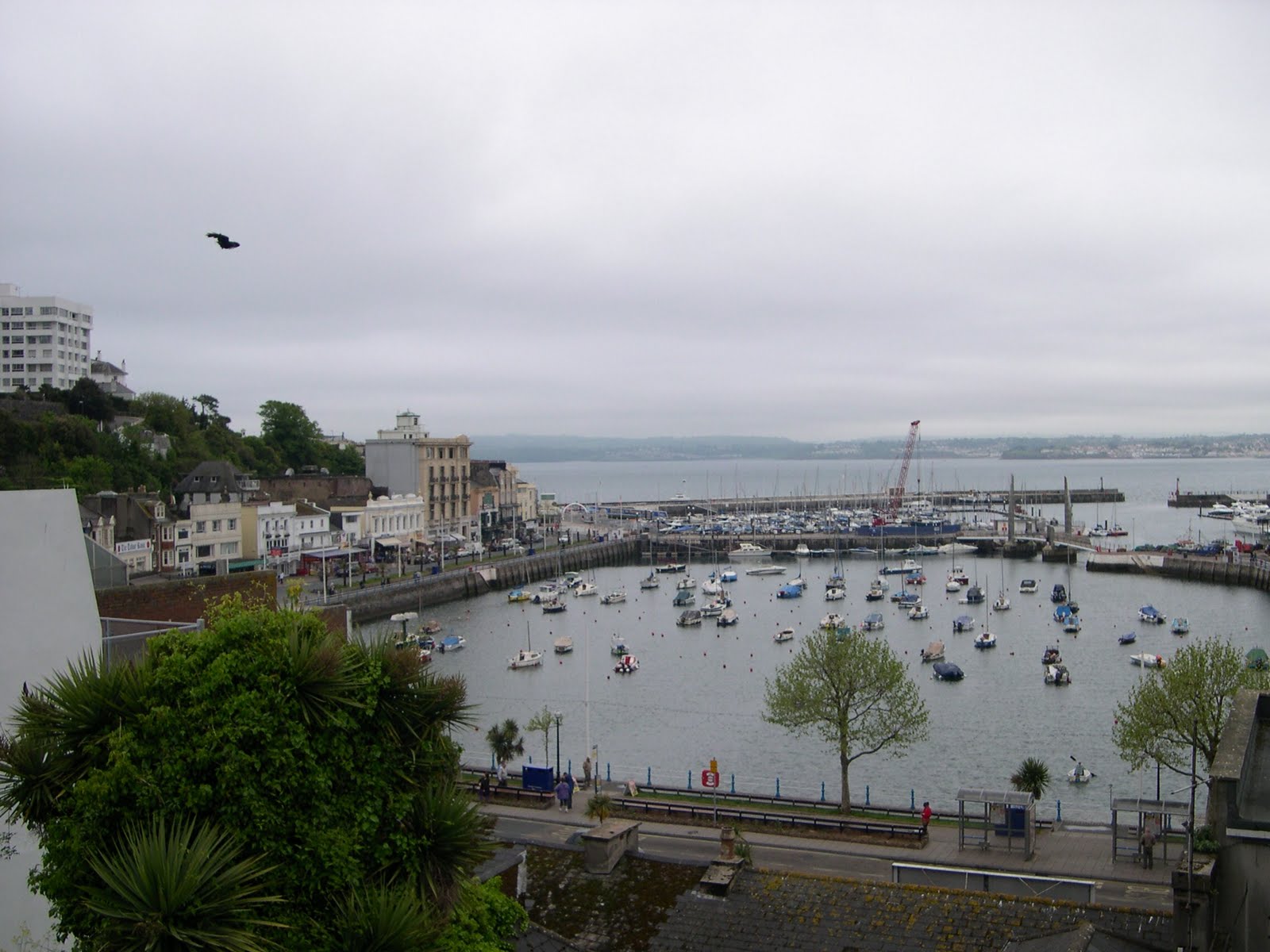
A view over Torquay Devon. A beautiful town on the Devonshire coastline hosting sports of every description.


Buckfast Abbey, a living monastery where the tranquility of the gardens was interrupted by the songbirds.

Buckfast Chapel showed the differences of the faith experienced at this magnificent site at Buckfastleigh.

Travelling through the Devon and Cornwall countryside is an adventure that anyone young or old would enjoy.
At Bodelva, St Austell you can wander through the steamy tropics in the largest greenhouses in the world. The Eden Project is a statement of art and architecture. A charity working to make things happen.
The Eden Project is owned by the Eden Trust, an educational charity. I visited this charity on the 18th May, the exhibits, took me back to areas that I have visited which included the Mediteranean, the Africas, and South America. The purpose of this educational feat in Cornwall is to engage, entertain and inspire the imagination of us all.

Eden’s Rainforest Biome took me on a fascinating journey of discovery into the humid tropical regions of the world, I travelled up 69 steps to the waterfalls of Argentina a prolific display of vegetation that grows there, and all the wonderful things they give us. The Rainforest Biome is an impressive piece of engineering.

It contains nearly 1,129 plants from the main rainforest regions: South-East Asia, West Africa, South America and the tropical oceanic islands, particularly the Seychelles and St Helena. Within this there are over twenty different displays, from a Malaysian Garden to a banana plantation.

Monday, 8 March 2010
Tribal Wives and others
I forgot to mention that I have other famous people within my family.

Jon my son is a film editor specialising in documentaries a collection of his works are displayed on http://www.editide.co.uk/
Jon works as part of a production team. One of the groups he worked for were present at the Emmy awards in New York 2006 and the Oscar ceremonies. Jon works to companies such as BBC, Diverse, Keo Films, Optomen Television, with Mama Cherie and Gordon Ramsay which was the programme at the Emmy awards in 2006.
And the infamous met up, Gordon Ramsay... and Jon working to Optomen and Sir Gordon Ramsey on the 13th November 2007 in Ramsey's Kitchen Nightmares Optomen Television!!.
In 2009 he recently worked for Optomen on a production for BBC 2. Also Love Production, and additionally the Spring production with the very lovely, Hugh Fernely Wittenstall on Channel 4.
More recently with Diverse film productions producing Tribal Wives shown 15th June 2010 BBC 2.
Watching Secret Millionnaire on Channel 4 focusing on child carers: I sat cocooned in my pink blanket looking like a pink marshmallow-listening to the man saying this was the most moving of all the secret millionnaires-20 minutes later I am sitting there crying over Lewis and Sophie..well done Jon for bringing humanity into the front room
Another author a historian an acclaimed author of the dramatic story of:
"A Life for A Life The Real Story of Mary Ball" A NOVEL- www.eugep.com.
ISBN 3 933570 Price £19.00. Many will have read my investigation of the story of Mary Ball. This is now going to press as a second edition in paperback with Rowe Books.
The Defiance of Mary Ball by Robert Muscutt (Paperback - Jun 2011)
The Life, Trial and Hanging of Mary Ball by Robert James Muscutt (Paperback - 20 Jun 2011)
A Life for a Life: The Real Story of Mary Ball by Robert Muscutt (Hardcover - Oct 2008)
Translations from old languages (Exeter books) by Jane Earthy, W. Moelwyn Merchant and Robert Muscutt (Unknown Binding - 1967)

Penelope Price novelist and playwright. Penny's first production was performed in London in 2006, well done Penny. Penny has had a launch of her first novel at Foyles Bookshop in Central London in May 2010 we are all loooking forward to reading the book.

HOT OF THE PRESS June 2010.
East Sussex Health Trust
Celebrating 100 years of Nursing
2010 A Nightingales Tale
East Sussex County Council
7th Poetry competition
2010 A Nightingales Tale (2nd edition)
Two newly submitted poems for 21 Today- Foreward Press
Published 30th September 2009
2009 'Christmas comes'
Book Title "Seasonal gifts and Natures Glories"
Book reference FBP0625A0132
Foreward Press
Published 30th June 2009
2009 'I had everything to give'
Book Title "Loves Many Mysteries"
Book reference Z002450879
Foreward Press

Jon my son is a film editor specialising in documentaries a collection of his works are displayed on http://www.editide.co.uk/
Jon works as part of a production team. One of the groups he worked for were present at the Emmy awards in New York 2006 and the Oscar ceremonies. Jon works to companies such as BBC, Diverse, Keo Films, Optomen Television, with Mama Cherie and Gordon Ramsay which was the programme at the Emmy awards in 2006.
And the infamous met up, Gordon Ramsay... and Jon working to Optomen and Sir Gordon Ramsey on the 13th November 2007 in Ramsey's Kitchen Nightmares Optomen Television!!.
In 2009 he recently worked for Optomen on a production for BBC 2. Also Love Production, and additionally the Spring production with the very lovely, Hugh Fernely Wittenstall on Channel 4.
More recently with Diverse film productions producing Tribal Wives shown 15th June 2010 BBC 2.
Watching Secret Millionnaire on Channel 4 focusing on child carers: I sat cocooned in my pink blanket looking like a pink marshmallow-listening to the man saying this was the most moving of all the secret millionnaires-20 minutes later I am sitting there crying over Lewis and Sophie..well done Jon for bringing humanity into the front room
Another author a historian an acclaimed author of the dramatic story of:
"A Life for A Life The Real Story of Mary Ball" A NOVEL- www.eugep.com.
ISBN 3 933570 Price £19.00. Many will have read my investigation of the story of Mary Ball. This is now going to press as a second edition in paperback with Rowe Books.
The Defiance of Mary Ball by Robert Muscutt (Paperback - Jun 2011)
The Life, Trial and Hanging of Mary Ball by Robert James Muscutt (Paperback - 20 Jun 2011)
A Life for a Life: The Real Story of Mary Ball by Robert Muscutt (Hardcover - Oct 2008)
Translations from old languages (Exeter books) by Jane Earthy, W. Moelwyn Merchant and Robert Muscutt (Unknown Binding - 1967)

Penelope Price novelist and playwright. Penny's first production was performed in London in 2006, well done Penny. Penny has had a launch of her first novel at Foyles Bookshop in Central London in May 2010 we are all loooking forward to reading the book.

HOT OF THE PRESS June 2010.
East Sussex Health Trust
Celebrating 100 years of Nursing
2010 A Nightingales Tale
East Sussex County Council
7th Poetry competition
2010 A Nightingales Tale (2nd edition)
Two newly submitted poems for 21 Today- Foreward Press
Published 30th September 2009
2009 'Christmas comes'
Book Title "Seasonal gifts and Natures Glories"
Book reference FBP0625A0132
Foreward Press
Published 30th June 2009
2009 'I had everything to give'
Book Title "Loves Many Mysteries"
Book reference Z002450879
Foreward Press
Friday, 11 December 2009
Publications by Ann Hubbard

All the works published by Foreward Press are held on the book shelves of the British Library Bodlian Library, University Library Cambridge, National Library of Scotland, Library of Trinity College Dublin and the National Library of Wales.
The Pandora books are held in East Sussex Libraries.
Listed in below are copies of my work-Publication date- Title and Publisher
1996 “I read a book the other day”
BOOK TITLE PANDORAS BOOKS
ISBN 0953071200
1996 “I read a book the other day”
BOOK TITLE AWAKEN TO A DREAM
The International Library of Poets
ISBN 1-57553-181-X
September
1996-09-24 “The Unspoken Deed is on our streets.”
BOOK TITLE INSPIRATION FROM THE SOUTH EAST
Anchor Books
ISBN 1859303234/3285
1996 "Living histories view”
BOOK TITLE WAR AND PEACE
Anchor Books
ISBN
1996-11-13 “A friend a man you know”
BOOK TITLE A FRIENDLY BOOK
Anchor Books
ISBN 1859303048/3099
1996 -12-18 “I ask you seriously to think”
BOOK TITLE HAVE YOUR SAY
Anchor Books
ISBN 85930 405 2 / 400 1
1997 "In This Age"
BOOK TITLE KillinG Fields-When enough is enough
Poetry Now
ISBN 1861887051/7000
1994-Jaqui Lait and Peter Lilley: Lobbied the House of Lords Child support
DATE TITLE AND PUBLISHER
1997 "Theres a corpse"
BOOK TITLE
Anchor Books
1999-HASTINGS COLLEGE OF ART AND TECHNOLOGY_ FOUNDATION ART SHOW BTECH DIPLOMA-BASED ON SELF PORTRAIT..Reflecting Monet, Kollwitz, Picasso_medium printmaking, etching, oils pastels and photography.
1999 "In The Beginning"
BOOK TITLE Anchor Books-Southern Inspiration 1999
Anchor Book
ISBN 1859307507/7558
2002-CONQUEST HOSPITAL-ART IN HOSPITALS- OILS, including orchids, self portrait anuance of colours.
2002-09-30 "A Woman Below "
BOOK TITLE Inspirations From The South 2002
Anchor Books
ISBN 1859309321/9372
2002 " Regeneration"
BOOK TITLE Inspired revelations
Forward Press
ISBN 1844310426/0418
2003-07-31 “Little Love Lost”
Anthology Hastings Writers
2003-07-2003 "Finding Faith"
BOOK TITLE Inspired Relevations
Triumph House
ISBN 1844310418/0426
2004-09-17 “A Love Lost Life..”
BOOK TITLE Poetry Now South and South West England 2004
Poetry Now
ISBN 1844608492
2005-01-31 “Untitled ( Father Christmas..) ”
BOOK TITLE Expressions From Southern England 2005
Anchor Books
ISBN 1844183858
2005-02-28 “ Father Christmas ... ”
BOOK TITLE Take a Look Around
Anchor Books
ISBN 1844183904
2005-10 “The Last Train...”
BOOK TITLE Strandline No. 5
Hastings Writers Anthology 2005
2005-12 "A Space in Time"
POEMS FROM SOUTH ENGLAND 2005
Anchor Books
ISBN 1-84602-022-0
2006- "In christs own grip"
BOOK TITLE 2007
ISBN
2006- "Pomp and circumstance"
BOOK TITLE POPPY FIELDS 2007
ISBN PN0588A0232
2006- “ ORDINARY..”
BOOK TITLE Strandline No. 6
Hastings Writers Anthology 2006
2006- “ A SPACE IN TIME”..”
BOOK TITLE FIRST TIME
EDITED BY JOSEPHINE AUSTIN
ISBN 0266 0520
2006-LOBBIED PARLIAMENT-HOUSE OF LORDS MICHAEL FOSTER AND FRANK DOBSON IN RESPECT OF CUTS IN NHS SERVICES LOCALLY
2007-04-2006 " Venice"
BOOK TITLE THE LOVE BUG
Forward Press
ISBN 1844310426/0418
2006- " Peace in our future"
BOOK TITLE : Poets from Southern England [Anthology]
Anchor Books
Forward Press
ISBN 1844184439
2007-October " Meadow Dew"
BOOK TITLE Southern Verses- Regional Series 2007
Anchor Books
Forward Press
ISBN AB0612M0095
2007-October "The Cricket Pavilion"
BOOK TITLE Poetry Now Southern Poets
Poetry Now
Foreward Press
ISBN-PN0612Q0003
2007 “ The afterlife..”
BOOK TITLE
2007 “ Fairie Romance..”
BOOK TITLE Strandline No. 7
Hastings Writers Anthology 2007
2008 “Diamante-a South American River”
Book Title Natures Paradise.
Book reference FPB0616MO116
Foreward Press
2008 "As they reminisce"
Book Title "Foreward Press Poets 2008-South east England"
Book reference FPB0620DH0133
Foreward Press
Published 30th June 2009
2009 'I had everything to give'
Book Title "Loves Many Mysteries"
Book reference Z002450879
Foreward Press
Published 30th September 2009
2009 'Christmas comes'
Book Title "Seasonal gifts and Natures Glories"
Book reference FBP0625A0132
Foreward Press
October 5th 2009- IFL requested my blogspot to represent World Teachers Day
HOT OFF THE PRESS
Published 30th June 2009
2009 'I had everything to give'
Book Title "Loves Many Mysteries"
Book reference Z002450879
Foreward Press
Published 30th September 2009
2009 'Christmas comes'
Book Title "Seasonal gifts and Natures Glories"
Book reference FBP0625A0132
Foreward Press
Two recent submissions:
2010 A Nightingales Tale
A day to celebrate Nursing at Conquest Hospital
2010 A Nightingales Tale
7th annual poetry competition
EAST SUSSEX COUNTY COUNCIL
2012 Art exhibition- Eastbourne District Hospital- Art in Hospitals
Media- silk
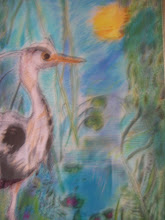
5 herons influenced by Hokusai (1760-1849)salt technique
Grey heron influenced by Oscar-Claude Monet (1840-1926)
--
Posted By twomeats to twomeats creates
Monday, 10 August 2009
Beachy Head Marathon- and comments from a runner 2009 and other runs

Jon ran along the Sussex Downs he completed a sponsored run in 3 hours 45 minutes. This is an area of outstanding natural beauty. It is situated in the East Sussex.
A comment from Jon follows:
"Firstly thank you very much for your sponsorship. We've raised £400 for The Stroke Association, and I'm expecting a little more yet. Hooray! I did complete the Beachy Head Marathon in 3 Hours and 49 minutes, and I came 39th. So all the hard training paid off. Below is a short race report, on how the run went for me.
I have to admit I was very scared in the weeks leading up to the race, partly due to a new pair of off-road trainers which almost crippled me (I chose not to run 26 miles in them) but mostly because it is a very hard course.
The day of the race was damp and foggy, but relatively warm, which was fine by me. The gun went at 9 o'clock and the race started up a very steep hill on to the Downs, the atmosphere was great, with everyone in good spirits. About 2 miles in and I heard the sound of bag pipes coming through the fog, and soon saw Joe the Lone Piper
stood to attention shrouded in the mist. Then heading across the
hills the rain came down, and people started to slip and slide around
a bit, at one point my trainers were completely caked in mud.
There were plenty of people to cheer us along, and it was brilliant
to see my Dad and Nan at Jevington. The first third of the course was fairly hilly, and it wasn't until about 8 miles that there were refreshments. I decided to walk through the drink station to have a little rest before tackling the next hill. Occasionally the fog would clear allowing a glimpse of the beautiful surroundings. I took the down hills in my stride savoring gravities help and literally
bounding along. At Alfriston I was cheered on by Penelope and my Mum.
Heading up Bostal Hill I felt strong, the hills hadn't proved too bad
as yet. Then came the steps, I said to the runner next me, 'This has
to be a joke'. But it wasn't, I started to jog up the uneven steep
steps. The fellow runner advised me these were the easy ones and we
had yet more to come. So I took his lead and walked up them at pace.
And yes the next steps were worse, but again the sound of bag pipes
brought a smile to my face. Joe the Lone Piper played at the top of
the steps.
The forest was full of magnificent autumn colour, and running through
them made me feel alive. Coming out of the woods on to the side of
the valley over looking the river Cookmere was a site indeed, but it
was around this point (at mile 20) that things started to get hard.
The path lead up on to the Seven Sisters, and as I jogged on, my
energy levels plummeted, and I knew that this was going to be very
hard indeed. So I started walking a bit, then jogging a bit, and walking a bit. until I got to the top. Then I jogged over the brow
and down, only to be faced with an even stepper up. And as I slowly made my way up each hill, only to be faced with another, and then another, I really thought I'd just give in at Birling gap and get a lift home.
Despite doing a lot of walking/jogging/walking up hills and feeling utterly exhausted, I did gain some hope in the fact that the runner
next to me and the runners ahead and behind were doing pretty much
the same thing. Then the refreshments on the penultimate peak saved me, a cup of water a chunk of chocolate. I jogged down the hill, and
some how found the resolve to jog up the other side, at the top a group of walkers clapped and cheered. Ah, the kindness of strangers, but I was thinking; 'Please stop clapping because I'm about to start walking again.' However I didn't and I was back in rhythm.
Coming in to Birling gap I heard the shouts of my family and friends cheering me on. And as I triumphantly approached them a stone hopped into my trainer. So I had to stop, which must have seemed quite funny, I hurriedly untied my shoe and removed the stone. Then I was on my way, Damian ran with me to the next car park. I think I was probably on the verge of tears and uncontrollable blubbing, and I just kept saying. 'This is not funny, this is not funny'. My sister Zoe, and her family cheered me on at the car park. Their son bounced on Wills shoulders and Zoe screamed words of encouragement at me. Brilliant. Then I really did start blubbing.
The last four miles were simply bizarre. I had a long conversation with a young runner about wether or not we'd just ran over the Seven Sister or not. It was confusing so I picked my pace up. Then Beachy head was completely shrouded in fog and it was so eerie. I couldn't see any other runners or even markers to send me in the right direction. I thought 'great this is the bit where I end up in the sea'. I found my way out of the fog and back down the very steep hill to the finish line. Everyone cheered me across the finish line and I was almost sad that it was over. I was exhausted and over come with emotion but it was worth every step."

The Seven Sisters Country Park covers 280 hectares of chalk cliffs, meandering river valley and open chalk grassland. It is a popular place for a number of outdoor activities including the Beachy Head Marathon.

Welcome to this fundraising page for The Stroke Association.
A link for sponsoring this worthy cause is http://www.justgiving.com/Jon-Hubbard/
Raising money for
The Stroke Association
Charity Registration No. 211015 (England), SCO37789 (Scotland)
The Stroke Association is a registered national charity solely concerned with stroke. We aim to reduce strokes through research
What is a stroke? - strokes and TIAs explained including the main types, the effects they may have, and common causes.
Preventing a stroke - what can be done to reduce your risk of stroke, including when a stroke or TIA has already occurred.
When a stroke happens – how strokes are treated, including hospital tests and treatment and longer-term rehabilitation.
After a stroke - what practical, emotional and financial support is available for stroke survivors and their carers.
Stroke rehabilitation - how to work towards regaining skills and adapting to life after stroke with professional help.
The Stroke Association - what The Stroke Association does and how we may be able to help if stroke affects your life.

The Beachy Head Marathon is one the biggest off-road marathons in the UK. Formerly known as the Seven Sisters Marathon, it is popular for its scenic and challenging route through the South Downs countryside.
The Country Park is named after the famous Seven Sisters that form part of the chalk cliffs on the Sussex Heritage Coast, one of Britain's finest unspoilt coastlines. It is situated at Exceat in East Sussex, just off the A259 between Eastbourne and Seaford.


Jon prefers a challenge the Half Marathon was farmyard fresh, in the rolling English countryside near to the Cotswold Way. He was keeping his mind (and body) amused after training on suburban roads, with room to run and take in the ambience of Horton in the South Gloucestershire the place Hogweed Hilly Half Marathon.
The Hogweed Trotters, the attempt at staging a Half marathon appeared to be flawless. The race pack included, a map with some pictures of what we might expect to see during the race and a course profile which left the runner in no doubt about the hills that lay ahead. And they were daunting pre warned of the 8th and 9th area of the run was onorous.
The course testing and not for the faint-hearted but Jon increased his personal speed up and down (and in Hogweed country what goes up most certainly does go down in equal measure). Well worth the effort. The first testing climb comes in the second mile, after which the course undulates until miles 7 to 9 when Kilcott has to be overcome. Kilcott is a hill that never seems to end - it just goes on and on and on - with a nice dogleg in the middle to tease you into thinking that you’re approaching the summit with Kestrels circling. But from there its all downhill, amost, before a last long downhill all the way to the finish.
A friendly run hosting 300 runners, which was blessed with a hot day. The marshals were friendly and supportive throughout, the route well marked, and with plenty to drink en route.
A goody bag was a treat at the end of the race which included a Hogweed Hilly Half T-shirt.

Wisely and slow; they stumble that run fast". W. Shakespeare. Jon did superbly at Hogweed Hilly Half V-What a lovely Mothers Day


Nearly 2000 runners completed a distance of 26.2M the 14/12/2008 the start timewas at 09:00 starting from Hastings Town Centre

Website: http://www.hastings-half.co.uk

The event organiser was Eric Hardwick M.B.E. - Race Director - Hastings Lions Club


Hastings hosted the Hastings 100th Anniversary Marathon Race (1908-2008)
on Sunday 14th December 2008. 9.30a.m.
The runners met outside Hastings Town Hall, (The Birthplace of Television, opposite where John Logie Baird sent the first television pictures. John Logie Baird [August 13, 1888 – June 14, 1946]) was a Scottish engineer and inventor of the world's first working television system) close to the original Start in 1908, as a reflection our M.P. Michael Foster will start the Event as, his M.P. predecessor Arthur du Cros did in 1908
The route headeds out of Hastings on Queens Road. For the first three and a half miles the roads will be closed to traffic. The runners took running refreshments at the three mile point at St. Peter and St. Paul(Parkstone Road) Church. The route continued along The Ridge(from Hillside Road),turn left and keep to left hand path. Past The Conquest Hospital. Many thanks to consultants and others who took part in this gruelling exercise.
The course carried on past the Harrow and along past Queensway junction to when path finishes on left, the route was well directed by course organisers over the road to a pathway to the right at the 5 mile point. Another running refreshment was available at Bannatynes(Beauport Park) roundabout, well done to Bannatynes members for their volunteers and runners.
The runners continued alongside the Beauport Park wall, and past the Black Horse Pub Drink Station, where the path finished for approx. 100 yards. Picking up the route at Crowhurst Park Bend where they entered the Historic Town of Battle the runners ran alongside the Battle Abbey Wall(The site of the famous ‘Battle of Hastings in 1066’. The Abbey Green hosted the 8 mile point and the Drink Station was organised by Yesterday’s World .
Following through Battle High Street, past the Almonry and Museum, the runners continued to Old Battle Workhouse and Claverham School.The 10 mile point at The Squirrel Pub, supplied running refreshment at a drink Station. Continuing to Catsfield, through Powdermill Lane Bend/junction. The 12 Mile point saw running refreshment at the White Hart Pub. The route continued to Ninfield.
Sidley hosted the 16 mile point for a running refreshment at The New Inn Pub. Progressing into Holliers Hill and past Bexhill Hospital until Tunnel under A.259. Leading into Belle Hill, the route traveled through Bexhill, and running refreshments was available at 18 mile point and drink Station at Dairy Crest in Terminus Road.
Cooden Drive at Beaulieu Road to other side of Cooden Drive supplied refreshments where the runners headed back to South Cliff. At this point the runners reached Bexhill(The Birthplace of Motor Racing) Promenade. A running refreshment was welcomed available at the 20 mile Drink station at Kiosk on Prom, just before the Famous De La Warr Pavilion. Continuing along Prom supported by the wind runners approached Galley Hill(Famous for Spike Milligan in his War years), a welcome stop at ‘Café on the Beach’ drink station (nearly 22 miles).
Terence Alan Patrick Seán Milligan KBE (16 April 1918 – 27 February 2002), known as Spike Milligan, was an Anglo-Irish comedian, writer, musician, poet and playwright. Milligan was the co-creator and the principal writer of The Goon Show, in which he also performed. Aside from comedy, Milligan played the trumpet, saxophone, piano, guitar and bass drum and well known to locals bothin Bexhill and Winchelsea.
The route continued past the Wreck of the Historic ‘Amsterdam’ and through to the Marina Beach Huts past the Hastings Sea Cadets alongside the railway line to the drink station at 23/24 miles. Travelling past the Beach huts to the Start/Finish of the popular Event Hastings half marathon. A welcome site of ‘Burton’s St.Leonards(The first purpose built seaside resort), where a Drink station was hosted at The Marina (Azur Restaurant)past the Hastings Pier. The run came full circle at the Town Centre.

Thanks to everyone who made this such a wonderful day.


Thanks for everyone that has sponsored Jon on this half marathon event..
http://www.justgiving.com/jonhubbard1

Well my travels in the New Year started with a trip to Bristol and what a trip that was...
Travelling with my map at my side and taking the scenic route I travelled through East Sussex, West Sussex, Hampshire and up through Wiltshire eventually appearing at a petrol station asking the famous statement of where am I now? Wincanton holds a special place in my heart...I headed off from there knowing the A37 would take me directly to Bristol.
Arrivng at Clifton Village a little later than anticipated but Millenium Square, Royal York Crescent and the awesome Clifton Suspension bridge will be in my heart forever.
Jon was at the end of the telephone and greeted me on my arrival...we met up with the hospitality of Clifton Village within an hour sharing complimentary sherry, a pizza and red wine.
The Avon and surrounding countryside is impressive and is spanned by Clifton suspension bridge which can be viewed from Jon and Penny's flat.
On Saturday we took a short walk into Bristol City, the Harbourside and its beautiful development was our first walk of many that week end. The Harbourside forms a new creative quarter in the heart of Bristol that is set to raise the city's profile internationally. The Harbourside Development is sculpted around open public spaces, which provide for the citizens of Bristol and for visitors to the city, room to appreciate the location and interplay of buildings, both old and modern.
Brunel's ss Great Britain was in front of us and Jon reminisced about his visit to the mother of all modern ships, designed by Brunel. The ss Great Britain was the largest at 98 metres long, the most powerful and modern ship of her time, she was launched in Bristol in 1843, she was the first propeller driven ship to cross the Atlantic to New York which took 15 days. It was the start of a new era in ocean travel. Built of iron, some said she would never sail. After travelling over a million miles, in 1886, she was abandoned and left to rot in the Falkland Islands. In 1970, following a massive fund raising campaign, she was towed back to Bristol and is currently being restored to her former glory. Of course comments were ooh! Jon I vaguely remember that.
Our first sighting of a cormorant diving for fish caused us great excitement. The development reminded myself of Tigre deltas, and also central London as the buildings on the banks of the floating harbour give the variety of old and new properties and a wealth of wildlife. We stopped for coffee and a danish pastry at the Mud Dock, a metal swordfish was hanging above the culinay area [ I am not sure if they served it. Perhaps I'll have to go back and see.] The views of Bristol's 13th-century cathedral - the northern backdrop to the quarter - and the meandering waterways that define its southern and eastern borders were a different to Bristol twenty five years ago.
We ate lunch at the Folkhouse where we listened to folk music and tased a sample of scrumpy cider and vegetarian cuisine.

We spent a leisurely Saturday taking in the wealth and breadth of the most gorgeous historical English city.
Saturday night we watched an old favourite Woody Allens "Matchpoint."
On Sunday, we walked across the Clifton Suspension Bridge, which spans the beautiful Avon Gorge, and is the symbol of the city of Bristol. For approximately 150 years this bridge which is a Grade I listed structure has attracted countless visitors from all over the world. A Bristol wine merchant who left a legacy to build a bridge over the Gorge, had an idea. The story of the suspension bridge unfolds the 1754.
In 1829, a competition was the dream of Thomas Telford and was judged by Thomas Telford, a leading civil engineer of the day. Telford rejected all the designs some were not suspension bridges and others did not meet Telford's expectations, so he submitted his own design but the decision to declare him the winner was unpopular.
So a second competition was held in 1830. A 24 year old gentleman, Isambard Kingdom Brunel was eventually declared the winner and appointed project engineer – his first major construction. The foundation stone was laid in 1831 but the project was dogged with political and financial difficulties and by 1843, with only the towers completed, the project was abandoned.
Brunel died prematurely aged 53 yrs in 1859. The Bridge was eventually completed as his memorial and finally opened in 1864. Although, designed in the early 19th century for light horse drawn traffic, the Clifton suspension bridge still meets the demands of 21st century commuter traffic. Over, 11-12,000 motor vehicles crossing it every day.
Many questions about the Clifton Suspension bridge;
What are the dimensions of the Clifton Suspension Bridge?
The total length of the Clifton Suspension bridge is, anchorage to anchorage 1,352 ft (414 m.) It's total span,from its the bridges centre to the centre of the piers are 702 ft (214 m), and overall width 31 ft (9.5m.) The width of the bridge, centre to centre of chains are 20 ft (6.1 m) and its height at deck level above high wateris 245 ft (76 m).
The height of piers, including capping 86 ft (26.2 m), and the height of saddles 73 ft (22.3 m.) The dip of chains 70 ft (21.3 m). All told this marvellous construction is an outstanding piece of engineering.
What materials were used to construct the Bridge?
The chains and suspension rods are made of wrought iron,and the piers (towers) are built principally of local Pennant stone. The Leigh Woods which form the south pier stands on an abutment of red sandstone. The Bridge deck is made of timber sleepers, 5 inches (12 cm) thick and is overlaid by planking 2 inches (5 cm) thick. To meet the need of modern traffic the deck has been covered with asphalt.
Later we viewed the Clifton Observatory and Camera Obscura an old snuff grinding mill near to the Suspension Bridge on the Downs. It is now home to the Camera Obscura and entrance to St Vincent's Cave. We travelled through the Leigh woods and a buzzard hovered above us, what a wonderful way to spend a weekend.
Jon regularly trains here (running), on the 16th March 2007 where he hopes to successfully run in the Hastings Half Marathon and the full marathon at Hastings. A monstorous achievement for any mortal..

Whilst in Bristol a grande finale was roast dinner at The Eldon House. I travelled comfortably along the M25 that evening listening to Jack Johnson.
Thanks to everyone who sponsored Jon tragically lost a close friend at the age of 36 years old and several relatives have suffered from this disease http://www.justgiving.com/jonhubbard1. Also thoose who sponsored Penny in the Bristol 10k..for the Macmillan nurses.

Jon completed the run in 1 hour 44 minutes

Jon regularly trains in Bristol, and he successfully ran in the Hastings Half Marathon accompanied with 5000 runners including Bernie Smith. A monstorous achievement for any mortal see below..
Subscribe to:
Posts (Atom)